
Business Reorganization
Company Representation - Business Reorganization
The Jones Bankruptcy Law Firm assists both businesses and individuals in filing Chapter 11 Bankruptcy, providing guidance through the complex process of reorganizing business operations and personal finances.
Chapter 11 Bankruptcy is a court- supervised restructuring process that enables financially distressed companies and high-debt individuals to reorganize their obligations, safeguard assets, and establish a sustainable plan for long-term stability.

BUSINESS REORGANIZATION
Business Reorganization provides businesses and individuals the opportunity to reduce debt, renegotiate contracts, stabilize cash flow, and regain control while continuing operations or maintaining personal financial stability. Businesses and individuals alike turn to Chapter 11 when They need a structured, strategic path to recovery, rebuilding, and moving forward with a stronger financial foundation.

No Debt Limit for Standard Chapter 11 Bankruptcy
Traditional Chapter 11: Available to all businesses, including large corporations, without any debt limit. However, the process is typically more complex and expensive.
In a standard Chapter 11 case, there is no requirement that the debtor’s debts be primarily business related debts, thus a business or individual may file for a Chapter 11 Bankruptcy. This is one of the key differences between traditional Chapter 11 and Subchapter V.
Subchapter V (Small Business Chapter 11 )
Subchapter V is a streamlined form of Chapter 11 Bankruptcy designed to help small businesses and qualifying individuals reorganize their debts quickly, efficiently, and affordably. It allows businesses to remain operational while owners work toward restructuring, negotiating with creditors, and rebuilding a stronger financial foundation.


Who Qualifies for Subchapter V?
Subchapter V is available to:
- Small business owner(corporations, LLCs, partnerships and sole proprietors)
- Individuals whose debts are primarily business-related
- Businesses or individuals with total debt below the federal Subchapter V debt limit.
To qualify, the majority of the debt must be business debt, not consumer debt.
Subchapter V Debt Limit
The Subchapter V debt limit is set by statute and adjusted periodically.
- As of April 1, 2025, the aggregate debt limit (secured and unsecured debt combined total) is $3,424,000 based on inflation adjustments and statutory requirements.
- Only noncontingent, liquidated debt counts towards this limit.
- During the COVID-19 pandemic, Congress temporarily increased the debt limit to $7.5 million, but that expansion expired on June 21, 2024.
- After expiration, the limit reverted back to $3,024,725 under 11 U.S.C. §1182(1) (Small Business Reorganization Act) and the Bankruptcy Threshold Adjustment and Technical Corrections Act (BTATC Act), then rose to the current $3,424,000 as part of the scheduled triennial adjustment.
Why Subchapter V Is Simpler Than a Standard Chapter 11
Subchapter V was created to make Chapter 11 Reorganization faster, less expensive, and more accessible for smaller businesses and individuals with business-related debt.
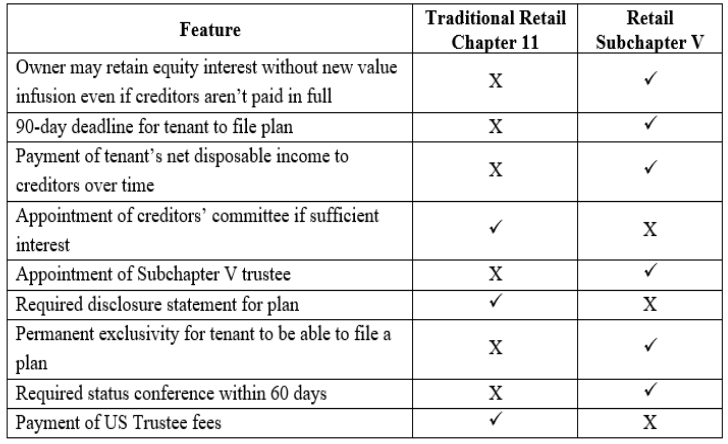
1. Debtor’s Exclusive Right to File a Plan, No Competing Plans Permitted
Only the debtor can file a plan—creditors are not permitted to file competing plans.
2. No Disclosure Statement Required
This removes one of the most time-consuming and costly components of a traditional Chapter 11.
3. Accelerated Timeline
A plan is typically required to be filed within 90 days, helping businesses stabilize quickly.
4. No Absolute Priority Rule
Business owners may retain their interest even if creditors are not paid in full — an option not typically available in a traditional Chapter 11.
What is the Absolute Priority Rule?
The Absolute Priority Rule (APR) is a core principle of traditional Chapter 11 bankruptcy. In simplified terms:
Junior parties cannot retain value unless senior parties are paid in full.
In the Chapter 11 context:
- Unsecured creditors are senior to
- Equity owners (shareholders, LLC members, partners, owners of the business)
Practical Effect: If unsecured creditors are not paid in full, then equity owners cannot keep their ownership interest in the business.
How Subchapter V Changes This (No Absolute Priority Rule) Subchapter V of Chapter 11 eliminates the Absolute Priority Rule for equity holders.
This means:
- Business owners may keep their ownership interest.
- Even if unsecured creditors are not paid in full
So long as the plan:
- Is fair and equitable, and
- Commits the debtor’s projected disposable income over the plan term (typically 3–5 years)
Example under Subchapter V:
- Business has $1 million in unsecured debt.
- The Plan proposes to pays $600,000 over five years.
- Owners propose to keep 100% business ownership.
- This is permissible in Subchapter V, but would fail in a traditional Chapter 11.
In a traditional Chapter 11 Bankruptcy, the above proposed plan would not be confirmed unless the business owners relinquish equity or inject qualifying new capital.
When the statement says owner are “not typically allowed to retain their interest,” in a traditional Chapter 11 Bankruptcy it literally means that the business owner may be forced to:
- Transfer ownership to creditors,
- Accept dilution or cancellation of their equity, or
- Lose the business entirely.
This is one of the most expensive and risky aspects of traditional Chapter 11 for small business owners.
5. Subchapter V Trustee
A trustee is appointed to facilitate negotiations, assist with administration, and support plan implementation, thereby simplifying the process for the debtor.
6. Lower Overall Costs
Streamlined procedures, fewer hearings, and reduced documentation results in substantially lower legal and administrative expenses.
7. Flexible Repayment Terms
Plans last 3 to 5 years and are funded with projected disposable income, offering a structure similar to Chapter 13, but tailed to business debtors.
How Subchapter V Compares to Chapter 13 and Traditional Chapter 11
Unlike Chapter 13 (restricted to individual only) or a Subchapter V—both Chapters 13 and Subchapter V require completing a 3–5 year repayment plan—a Chapter 11, on the other hand, allows individuals or businesses to propose a plan of any length needed. This flexibility makes Chapter 11 the preferred option for high-income individuals or business with debts that exceed Chapter 13 or Subchapter V.
Bankruptcy Litigation
Bankruptcy Appeals
The Jones Law Firm handles bankruptcy appeals. Jones understands the different legal skills that are necessary to handle appeals having won one of the highest historic verdicts in history decided by the late Honorable Judge Albert, in the unpublished case of In re Paul Bradford appealed to the 9 th Circuit from the United States Bankruptcy Court, Central District California, Riverside Division. The Jones Firm is uniquely positioned to assist you with your appeal whether you are bringing the appeal or defending against an appeal.